California Debt Collection Defense

You were served. You have 30 days. Here's how I won twice without a lawyer.

A complete defense kit built from two real California debt cases, both fought pro se and both won. Open it tonight, know your options by morning.

Get the Complete Kit · $57 Instant download · All files included
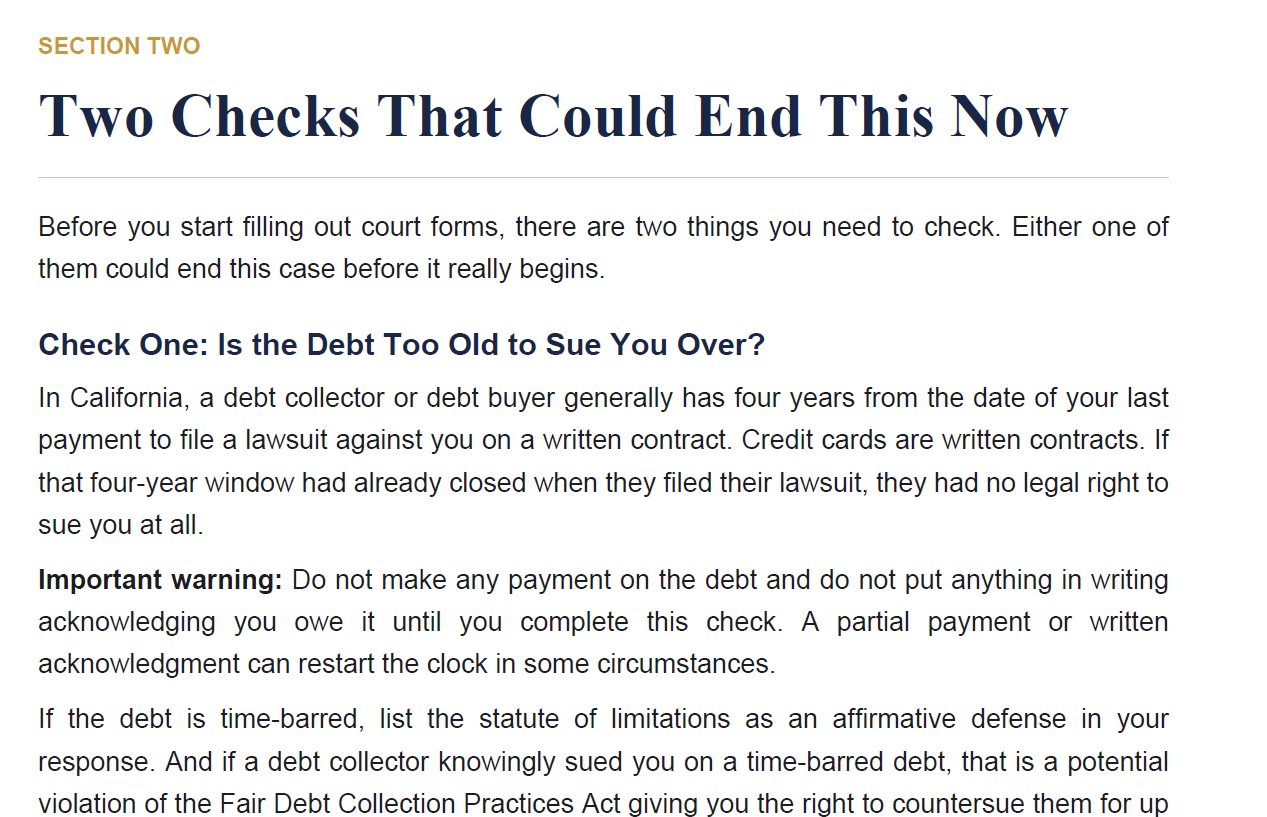
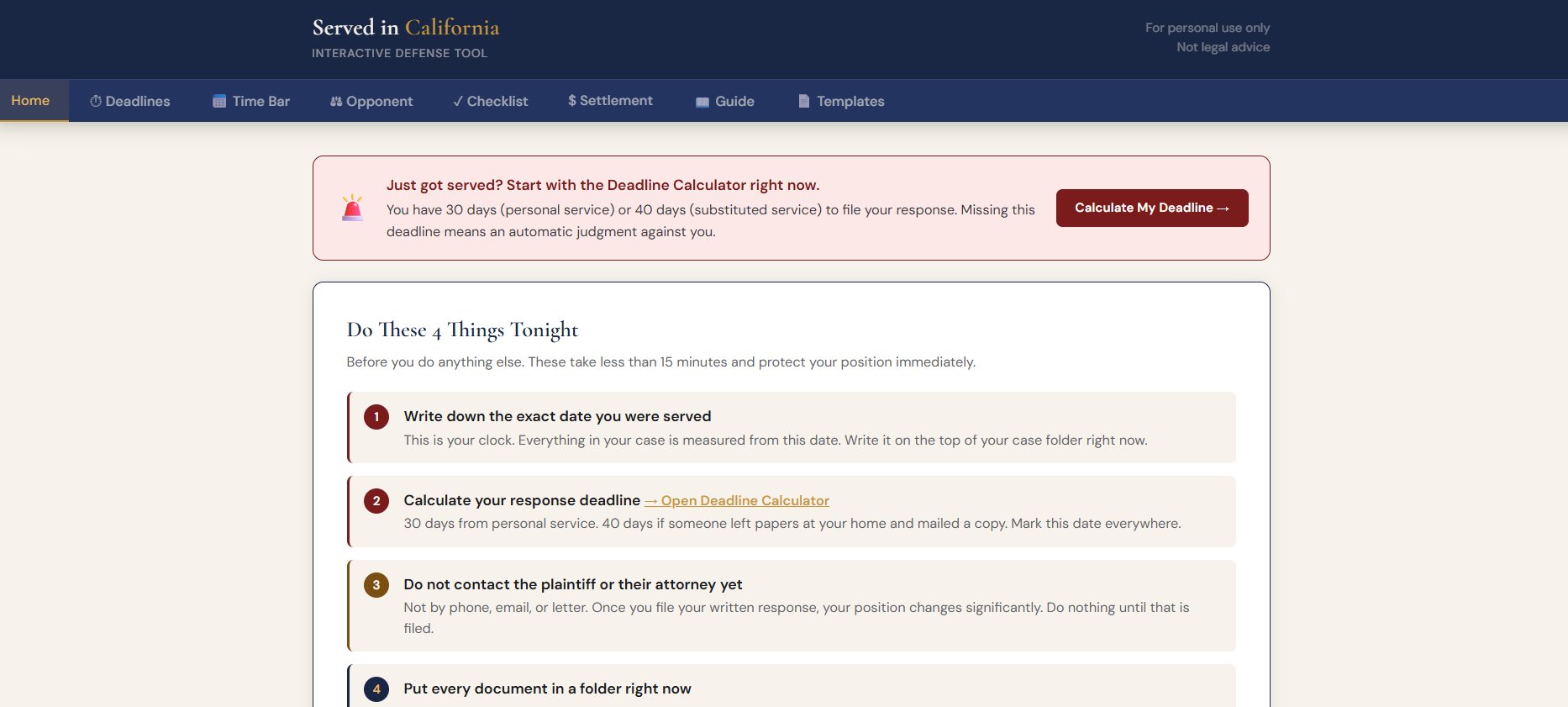
Screenshot of the Served in California Interactive Defense Tool, showing tabs for Deadlines, Time Bar, Opponent, Checklist, Settlement, Guide, and Templates.

California gives you 30 days from the date of service (40 if you were served by substituted service) to file a written response. Miss that deadline and the court can enter a default judgment against you, even if you have a valid defense. The calculator below tells you exactly when yours falls.

How many days do you actually have left?

Most people get this wrong. The deadline depends on how you were served, and the clock is already running. Enter your serve date and find out where you stand right now.

Enter your serve date to see your deadline and how many days you have left.

Built from two real California cases.

I was served with a debt collection lawsuit in California. Then it happened again. The first case was filed by a professional debt buyer backed by a law firm that runs hundreds of these cases through California courts every month. The second came from the original creditor itself, a national bank with its own in-house collections team.

I had no legal background. I had no lawyer. I had a deadline, a stack of papers I didn't understand, and a lot of late nights reading California code on leginfo.ca.gov.

I won both cases. Not by luck, but by learning exactly how these cases work and where they fall apart.

I learned what the collectors have to prove, where their cases collapse under the weight of their own paperwork, and which procedural tools give defendants real leverage. This kit is everything I learned, organized so you can move fast from day one.

Chris, California
The plaintiffs I faced Midland Funding, CACH LLC, and Capital One. If any of these names are on your summons, you are looking at the exact playbook I built against them.

Both cases. Both dismissed.

Real court records, redacted for privacy. These are the outcomes the kit was built from.

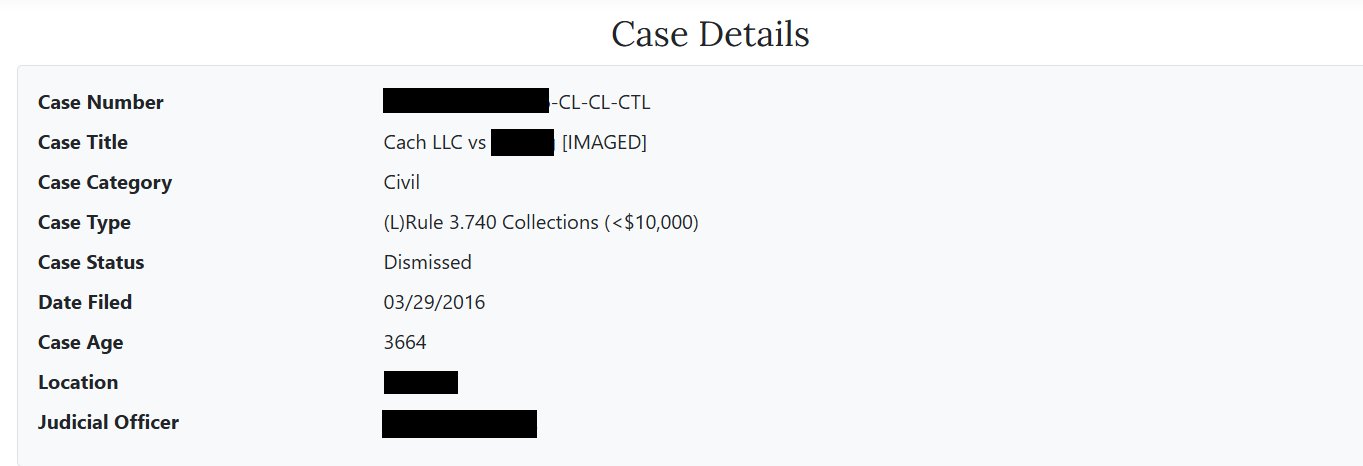
CACH, LLC

Civil collections case, filed 03/29/2016. Dismissed with prejudice.

Court case details for Cach LLC showing Case Status: Dismissed, Case Category: Civil, Case Type: Collections under $10,000.
Court docket: Case Status: Dismissed
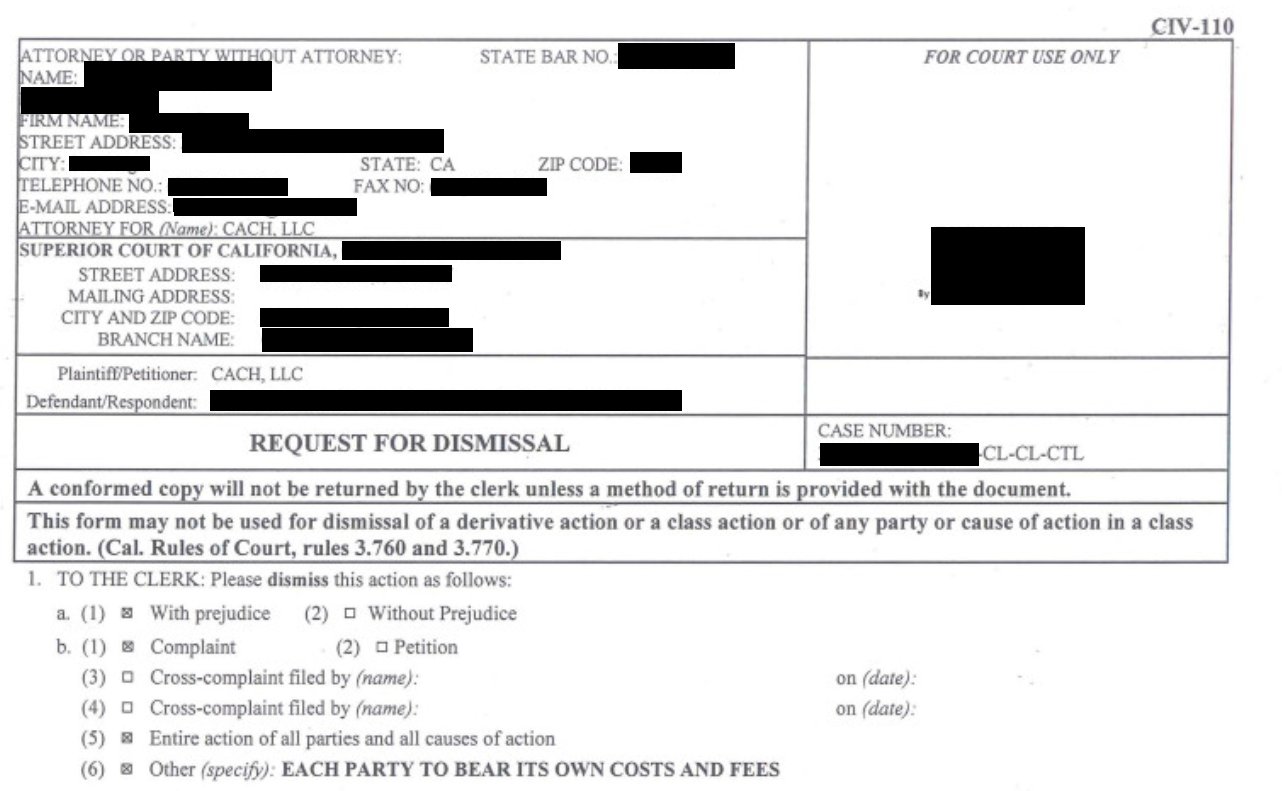
CIV-110 Request for Dismissal form filed by CACH LLC's attorney, showing dismissal with prejudice and each party bearing its own costs and fees.
CIV-110: Request for Dismissal, with prejudice

Capital One Bank (USA), N.A.

Civil collections case, filed 07/08/2016. Dismissed.

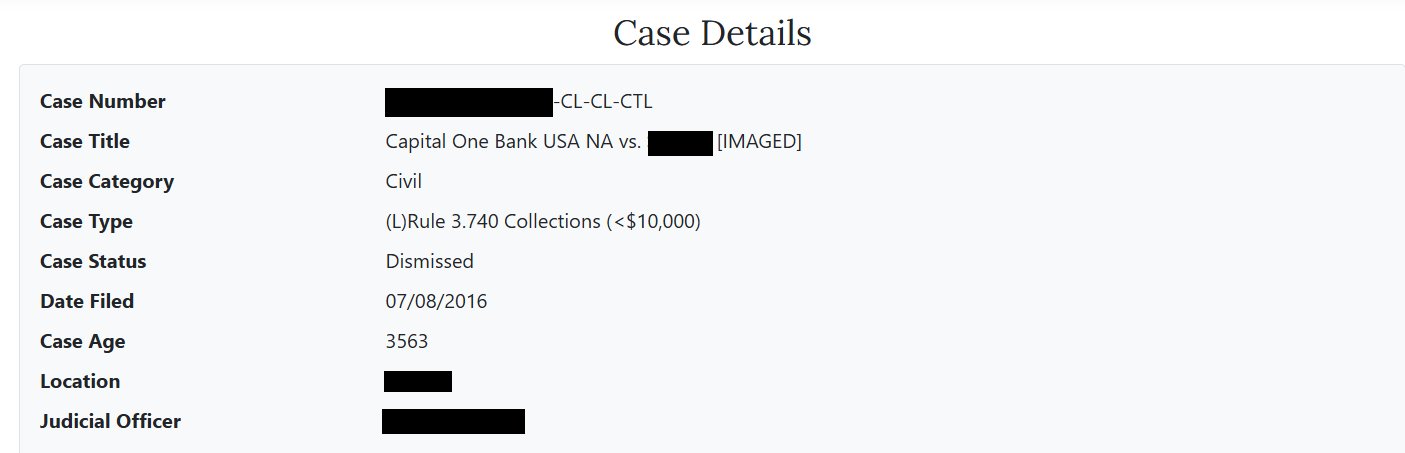
Court case details for Capital One Bank USA NA showing Case Status: Dismissed, Case Category: Civil, Case Type: Collections under $10,000.
Court docket: Case Status: Dismissed
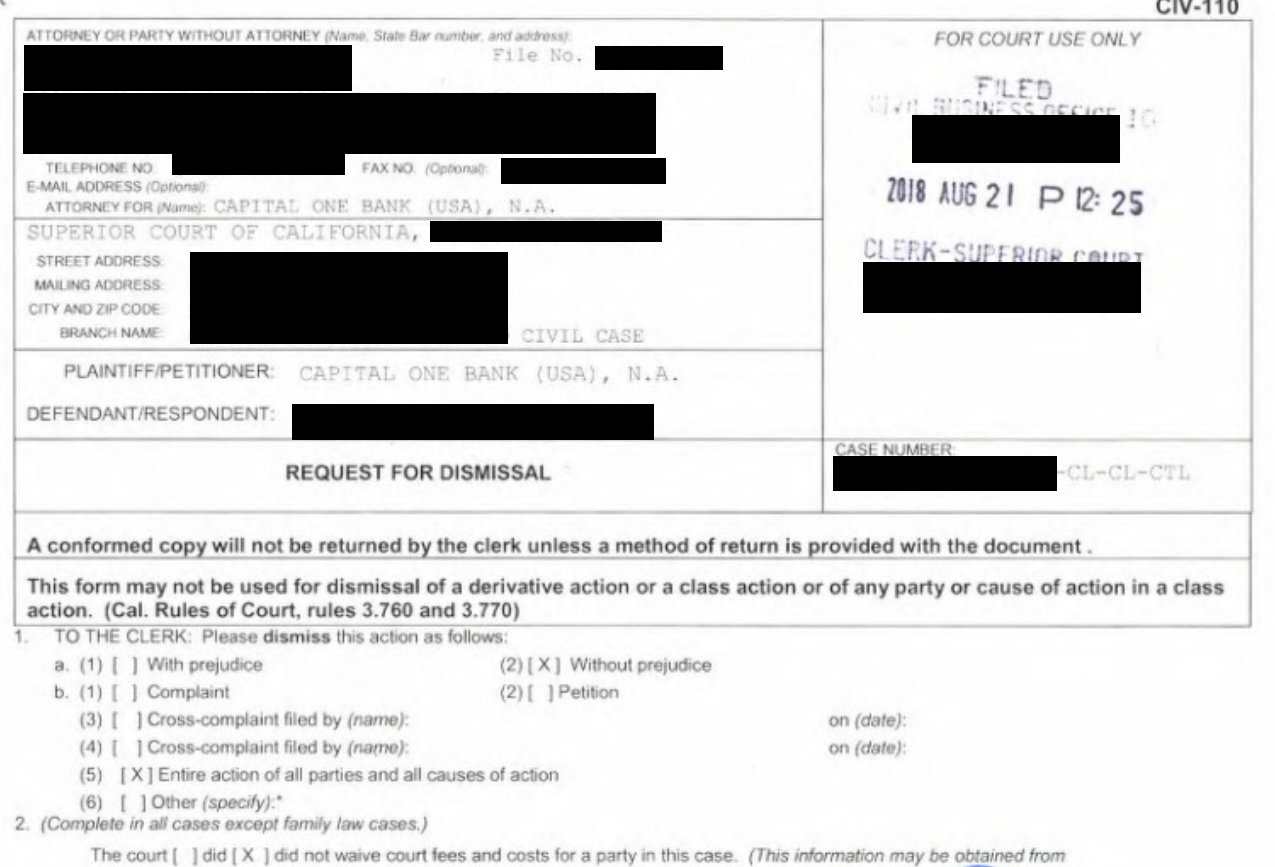
CIV-110 Request for Dismissal form filed by Capital One Bank (USA) N.A., court-stamped August 21, 2018, showing dismissal of entire action.
CIV-110: Request for Dismissal, court-stamped

Personal information redacted. Case numbers, court locations, and judicial officers removed for privacy. Case type, plaintiff names, filing dates, and dismissal status are exactly as they appear in the public court record.

Within 15 minutes of opening the kit, you will know:

01

Your exact response deadline

02

Whether the debt may already be time-barred

03

What kind of plaintiff you're up against

04

Exactly what to do next

The complete system.

Every file works together. Open the Start Here file first. It walks you through the full system in order.

Interactive Defense Tool

Five functional tabs built for someone who just got served and needs answers fast. Works offline in any browser. No account, no login, no data collected.

  • Deadline Calculator: your exact filing deadline by date
  • Statute of Limitations Checker: find out if the debt is already time-barred
  • Opponent Identifier: decision tree mapping who's suing you and what it means
  • Case Checklist: every task from Answer through trial
  • Settlement Calculator: model offers and compare outcomes

The PDF Guide: 10 Sections

Every stage of a California debt collection case, explained in plain language with real examples drawn from the cases I fought. Written for someone who has never opened a court filing in their life.

10 Fill-in Templates, Ready to File

The exact filings I used, in editable form. Replace the bracketed fields with your information and you have a draft ready to review and file.

  • General Denial / Answer
  • Motion to Compel Arbitration
  • CCP §96 Demand
  • Motion in Limine
  • Settlement Offer Letter
  • …and five more

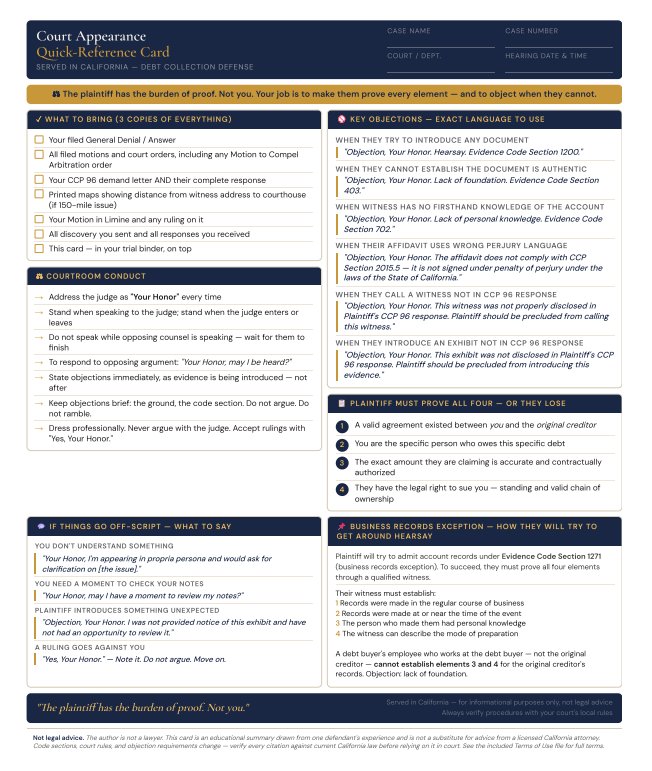
Court Appearance Quick-Reference Card

One page. Print it the morning you go to court. Every key objection with the exact wording, every Evidence Code section you might need, and what to say when things go off-script. The card I wish I had on day one.

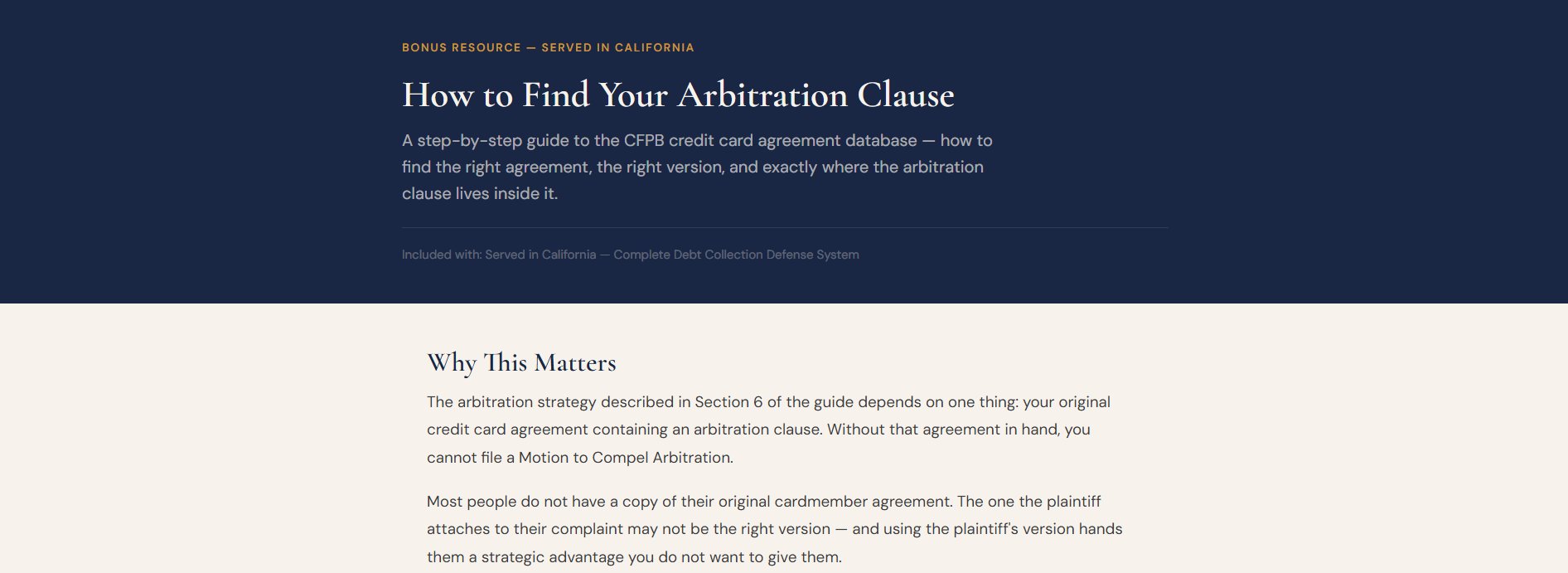
CFPB Agreement Walkthrough

Step-by-step screenshots showing exactly how to find your original credit card arbitration agreement in the CFPB's public database. This is the document the arbitration strategy depends on, and most people never know it's free and online.

10 sections. Every stage of your case.

Each section is a chapter you can read in 10–15 minutes, written in plain language with real case examples. No filler.

01

What just happened, and what to do in the next 72 hours

How California debt cases actually work, who's involved, and the four things to do tonight before you do anything else.

02

Filing your General Denial

The one-page response that preserves all your defenses and buys you the time you need to build a real case.

03

The CCP §96 Demand

The procedural tool that forces the collector to disclose their evidence before trial. Many cases evaporate at this step alone.

04

Discovery

What to send, what to expect back, and how to use their responses to build your defense in writing.

05

Statute of limitations

How to figure out whether the debt is already time-barred under California law, and how to raise the defense properly so it sticks.

06

The arbitration strategy

The single most powerful move against a debt buyer. Why it works, when to use it, and when not to.

07

Motion to Compel Arbitration

The actual filing, step by step, including the fill-in template and what to attach.

08

Motion in Limine

How to exclude the collector's hearsay evidence before trial even begins. Often the difference between losing and winning.

09

FDCPA counterclaims

When the collector broke the law, you can countersue. How to spot it and how to use it as leverage.

10

Settling

How to read the room, when to make the first move, and how to land a number you can actually live with.

Why arbitration makes debt buyers fold.

"It costs them more to fight you in arbitration than the debt is worth."

Most credit card agreements contain an arbitration clause. Debt buyers love that clause when it keeps consumers out of court. They hate it when defendants invoke it against them.

Here's the math. When you compel arbitration, the debt buyer suddenly has to pay arbitration filing fees, hire counsel familiar with arbitration procedure, and spend months on a single case instead of running it through the assembly line of small-claims court. Their entire business model is volume. Arbitration breaks volume.

So they do what you'd expect. They drop the case, or they offer a settlement that's a fraction of the original demand. Not always. Not in every case. But often enough that the kit walks you through exactly when this strategy fits, how to find the arbitration clause in your specific cardholder agreement, and how to file the motion that triggers it.

What you'll actually be working with.

Real screenshots from the kit. The interactive tool, the guide, and a peek at the bonus that comes with it.

The Interactive Defense Tool open in a browser, showing the home screen with the Deadline Calculator prompt and a 'Do These 4 Things Tonight' checklist.
Interactive Defense ToolFive functional tabs. Works offline in any browser.
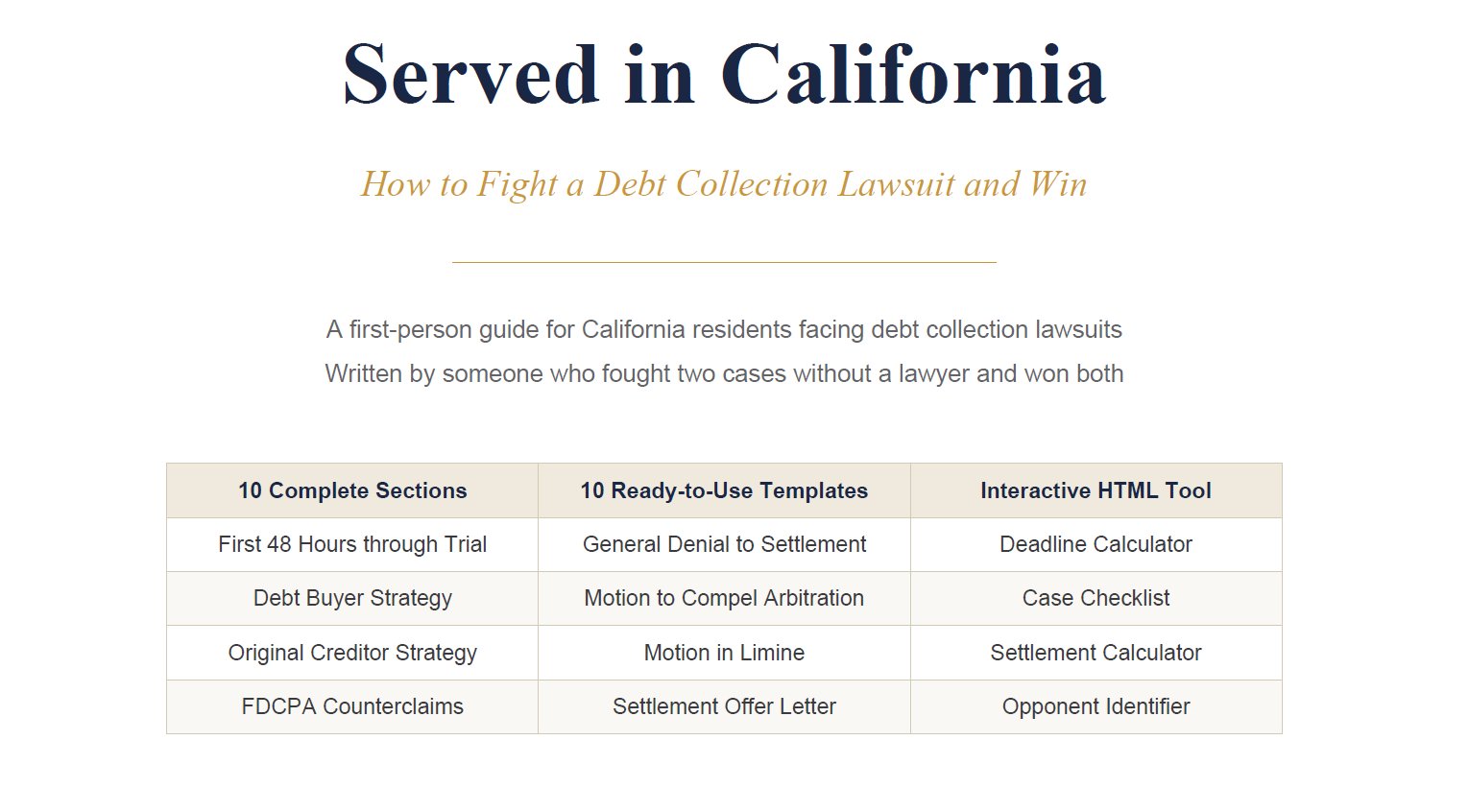
The cover of the PDF guide titled 'Served in California: How to Fight a Debt Collection Lawsuit and Win,' showing a summary table of 10 sections, 10 templates, and the interactive HTML tool.
The PDF Guide10 sections, plain language, written for non-lawyers.
A page from the PDF guide titled 'Two Checks That Could End This Now,' explaining the statute of limitations check on a debt before filing court forms.
Inside the GuideA real page from Section Two on the statute of limitations.
Bonus · Included Preview of the Court Appearance Quick-Reference Card bonus, showing the title and section structure with the detailed objection language locked.
Court Appearance CardOne-page printable bonus. The morning-of-court reference.
Bonus · Included Preview of the CFPB Agreement Walkthrough bonus, showing the title 'How to Find Your Arbitration Clause' and the opening explanation of why this step matters.
CFPB Agreement WalkthroughStep-by-step guide to finding your arbitration clause.
Midland Funding
CACH, LLC
Capital One

The plaintiffs the kit was tested against. If one of these is on your summons, this kit was built for your exact situation.

Who this is for (and who it isn't).

This kit was built for a specific situation. Read both columns before you buy. I'd rather you skip the kit than waste $57 on something that doesn't fit.

This is for you if…

  • You've been served with a civil debt lawsuit in California
  • The plaintiff is a debt buyer, collection agency, or original creditor
  • You want to understand your options before deciding what to do
  • You're considering representing yourself (pro se)
  • You want to understand the arbitration strategy before you commit to it

This is not for you if…

  • Your case involves a large amount and you have significant assets to protect
  • Wage garnishment is already in effect
  • You are outside California (the rules and code sections won't match)
  • You need individual legal advice about your specific case

Questions people ask before they buy.

What if I've already missed my response deadline?

It depends on how late. If the deadline has passed but no default judgment has been entered against you yet, you may still be able to file your response. The court can accept a late answer if the plaintiff hasn't moved for default. The kit walks you through how to check.

If a default has already been entered, you'll need to file a motion to set it aside under CCP §473, which the kit doesn't fully cover and is genuinely worth talking to a lawyer about. Either way, don't assume it's over. Open the kit tonight, run the calculator, and find out where you actually stand.

What if the plaintiff is the original creditor (Capital One, Chase) instead of a debt buyer?

The kit covers both. Most of the procedural strategies (deadlines, the General Denial, discovery, motions in limine) work the same regardless of who's suing you. One of the cases I won was against an original creditor, so the kit was built with both opponent types in mind.

That said, original creditor cases are different. They have cleaner records than debt buyers, so the "your evidence is hearsay" attacks don't land as hard. Against an original creditor, the arbitration strategy and procedural defenses become more important than challenging their paperwork. The guide tells you which pieces apply to your specific opponent and which don't.

Does this cover medical debt lawsuits?

Partially. The procedural pieces (deadlines, the General Denial, discovery, motions, settlement strategy) all apply the same way. Medical debt has its own rules under California's Hospital Fair Pricing Act and there's typically no arbitration clause to compel, so the arbitration chapter won't help you. If your case is medical debt only, you'll get value from most of the kit but not all of it.

Will I have to physically appear in court?

Probably yes, at least once. Most California debt collection cases include at least one Case Management Conference, and if your case goes to trial, you'll appear for trial. Some appearances can be done by phone or video depending on the court and the judge. The guide covers how to find out which apply to your case.

The Court Appearance Quick-Reference Card was built specifically for the morning you walk in. It has the exact objection language, the four things the plaintiff has to prove, and what to say when something unexpected happens. Print it. Bring it. Use it.

How is this different from SoloSuit or hiring an attorney?

SoloSuit gets you a General Denial filed. That's an important first step, but it's the beginning of a defense, not a defense. After your Answer is in, you still need to handle discovery, motions, evidence challenges, and either trial prep or settlement. None of that is in a single auto-generated filing.

Hiring an attorney is the right call if you can afford one and your case involves significant assets. For most people facing a $3,000 to $15,000 debt suit, paying $300/hour out of pocket isn't realistic. This kit is for that gap. More than a single template, less than a retainer.

What if I follow the kit and still lose?

Honest answer: it can happen. I won twice, but I'm not promising you'll win. What I can tell you is that even cases that go the distance often end in settlements far below the original demand, because by the time you've made the plaintiff do real work, the math stops favoring them.

Worst case, you're in the same position you would have been in if you'd never opened the kit, except you fought, you forced them to spend money, and you learned how the system works. Best case, the case gets dropped or dismissed long before trial. The kit gives you the tools and the playbook. The outcome depends on your specific case.

Do I need a legal background to use this?

No. I had none when I started. The kit is written for someone who has never opened a court filing in their life. The Interactive Tool tells you what to do at each stage, the templates are fill-in-the-blank, and the guide explains every term in plain language the first time it appears.

Why is there no refund?

Two reasons, both honest. First, you get every file the moment you check out. There's nothing to return. Second, the people this kit is built for are working against a deadline, and the moment you open it you have a calculator, a plan, and a stack of templates ready to file. That's the value, and it's delivered immediately.

So I do the work up front instead. The "Is this for you?" section above is written specifically to talk you out of buying if it's not the right fit. Read it carefully. If your situation is in the "not for you" column, please don't buy the kit. I'd rather you find what you actually need.

Is this current with California law?

Yes. The kit references current California Code of Civil Procedure sections, current Evidence Code sections, and current Rules of Court. That said, laws and court rules change, and you should verify every code citation against current California law before relying on it. The guide tells you exactly where to check. leginfo.ca.gov is free and authoritative.

What format are the files in?

Everything is a file you download once and own forever. The Interactive Tool is a single HTML file that opens in any browser, online or offline. No install, no account, no data leaving your computer. The guide is a PDF. The templates are editable documents. The Court Appearance Card is a print-ready PDF. No subscriptions, no logins, no ongoing anything.

Don't let the deadline pass.

Everything you need is in one download. Open it tonight, know your options by morning.

$57
Instant digital download · All files included
Get the Complete Kit
Why all sales are final

You get every file the second you check out. Nothing to return, nothing to wait for. If you're not sure it fits your situation, read the "Is this for you?" section above carefully. It's there to talk you out of buying if it's not the right fit.